
Custom vs Modular Retail Fixtures: Which Approach Is Right for Your Store?
Date Posted:23 September 2026
 Custom vs Modular Retail Fixtures: Which Approach Is Right for Your Store?
Choosing a fixture solution that works for your products, space and future retail plans
Retail fixtures do much more than hold stock.
They influence how products are presented, how customers move through a store, how easily merchandising can be changed and how consistently a retail concept can be delivered across multiple locations.
One of the key decisions retailers need to make is whether their store requires a custom fixture solution, a modular system or a combination of both.
There is no single approach that works for every retail environment. The right solution depends on the products being displayed, the available space, merchandising requirements and how the store is expected to change over time.
What are modular retail fixtures?
Modular retail fixtures are built around repeatable components that can be configured in different ways.
Shelving, uprights, bays and accessories can often be adjusted, moved or reconfigured as product ranges and merchandising requirements change.
This makes modular systems particularly useful for retailers that regularly update displays, introduce promotional ranges or operate across multiple locations.
A modular approach can help retailers achieve:
- Greater merchandising flexibility
- More consistent store layouts
- Easier fixture reconfiguration
- Repeatable components across multiple locations
- Simpler expansion or replacement over time
Rather than replacing an entire fixture whenever a merchandising requirement changes, modular elements can often be adjusted to suit new products, categories or layouts.
When does a custom fixture make sense?
Some retail environments require something more specific.
Custom fixtures are developed around the particular requirements of a product range, store layout or retail concept.
They can be especially useful when standard systems cannot make effective use of the available space or when the fixture needs to perform a very specific function.
A custom solution may be appropriate when retailers need to:
- Display unusually shaped or oversized products
- Make better use of challenging or restricted spaces
- Incorporate specific finishes or branding
- Integrate lighting, technology or specialist equipment
- Create a feature display or destination within the store
- Support a particular customer interaction or service
The fixture is designed around the requirement rather than asking the retailer to adapt the requirement to a standard system.
Start with the products
The product range should be one of the first considerations when selecting a fixture system.
Different products require different methods of display.
A store selling small packaged products may benefit from highly adjustable shelving and accessories, while bulky or unusually shaped merchandise may require a more tailored solution.
Weight, dimensions, stock volume, product visibility and replenishment requirements should all be considered.
Understanding how the merchandise needs to be displayed and managed helps determine whether a modular system will provide enough flexibility or whether certain areas need to be customised.
Consider how often the store will change
Retail environments are rarely static.
Seasonal ranges, promotional campaigns, new product categories and changing customer expectations can all affect how merchandise needs to be presented.
If a store changes regularly, modular systems can make those adjustments easier.
Shelves can be repositioned, accessories changed and bays reconfigured without replacing the entire fixture system.
For areas where the layout and product offer are more permanent, custom fixtures may provide an opportunity to create something more specific to the space and brand.
Think about consistency across multiple locations
Fixture selection becomes even more important when a retailer operates more than one store.
A repeatable modular system can help maintain consistency across multiple locations while still allowing individual stores to respond to different floorplans and site conditions.
This can make modular fixtures particularly useful for rollout programs.
However, not every location will be identical.
Custom elements can be introduced where a particular store requires a different solution, allowing the broader retail concept to remain consistent without forcing every site into exactly the same configuration.
Custom and modular can work together
The choice does not always need to be one or the other.
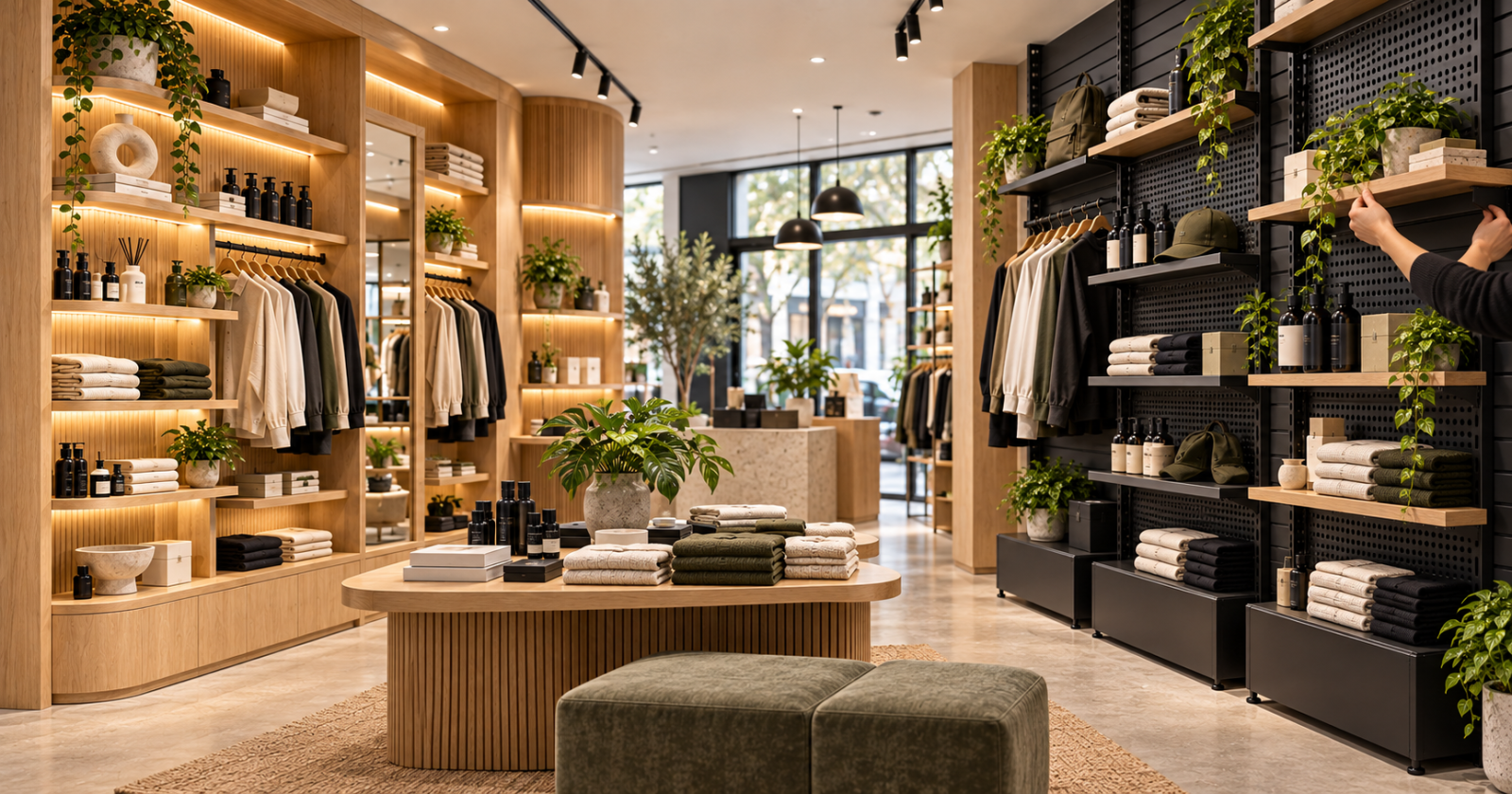
In many retail environments, the most practical solution is a combination of modular and custom fixtures.
A retailer might use modular shelving throughout the majority of the store while introducing custom fixtures in areas that require a more tailored approach.
These might include:
- Feature displays
- Service counters
- Promotional zones
- End-of-aisle displays
- Oversized product areas
- Technology displays
- Brand-specific installations
This approach provides a flexible and repeatable foundation while allowing important parts of the store to be designed around specific requirements.
Consider the future, not just the initial fit-out
Fixture planning should also consider what happens after the store opens.
Product ranges evolve.
Merchandising strategies change.
Stores are refurbished, expanded or rolled out into new locations.
When assessing a fixture system, retailers should consider questions such as:
- Can shelving be adjusted?
- Can accessories be changed?
- Can additional bays be added?
- Can components be replaced individually?
- Can the same system be used in future stores?
- Can the fixtures respond to changing product ranges?
A fixture system that can adapt over time can reduce the need for major changes every time merchandising requirements evolve.
Choosing the right solution for your store
The decision between custom and modular retail fixtures ultimately comes down to how the store needs to operate.
Products, space, merchandising flexibility, brand presentation and future rollout plans should all influence the approach.
For many retailers, the most effective solution combines both.
Modular fixtures provide flexibility and repeatability, while custom elements can solve more specific product, space or presentation challenges.
Retail fixture solutions designed around your store
Retail Fixtures Australia designs and supplies both modular and custom retail fixture solutions.
From individual displays and store refurbishments through to large-format environments and multi-site programs, our team works with retailers to develop fixture systems around the practical requirements of their products, space and operations.
Planning a new store, refurbishment or fixture upgrade?
Talk to Retail Fixtures Australia about creating a fixture solution designed around the way your store needs to work.
[email protected]
(03) 8787 3000