

Retail Fit-Out Security: Why High-Ticket Protection Starts in the Design
Date Posted:24 July 2026
Retail security is no longer something that can be added at the end of a project.
For retailers managing high-ticket products, the most effective loss prevention strategies now begin much earlier — at the planning, design and fit-out stage. Security today is not only about cameras, guards or product tagging. It is also about store layout, sightlines, fixture design, customer movement and the way products are displayed and accessed in-store.
At Retail Fixtures Australia, we see this shift clearly. More retailers are recognising that the physical environment itself plays a critical role in reducing opportunity, supporting staff safety and protecting valuable stock.
That is why retail fit-out security needs to be considered as part of the broader design solution from the start.
Retail Fit-Outs Need to Do More Than Look Good
Traditionally, retail fit-outs have focused on brand presentation, customer experience, workflow and merchandising. Those priorities still matter, but they now need to sit alongside another important requirement — risk reduction.
For stores carrying high-value or theft-prone products, the physical environment needs to do more. It must support visibility, reduce blind spots, improve passive supervision and create practical barriers to theft, while still maintaining a strong customer experience.
This means decisions around shop design, product placement, entry treatments and fixture access can no longer be treated as separate from store planning. They are central to it.
The Role Fixtures Play in Protecting High-Ticket Items
Fixtures are no longer just about display and durability. In many retail environments, they also form part of the security response.
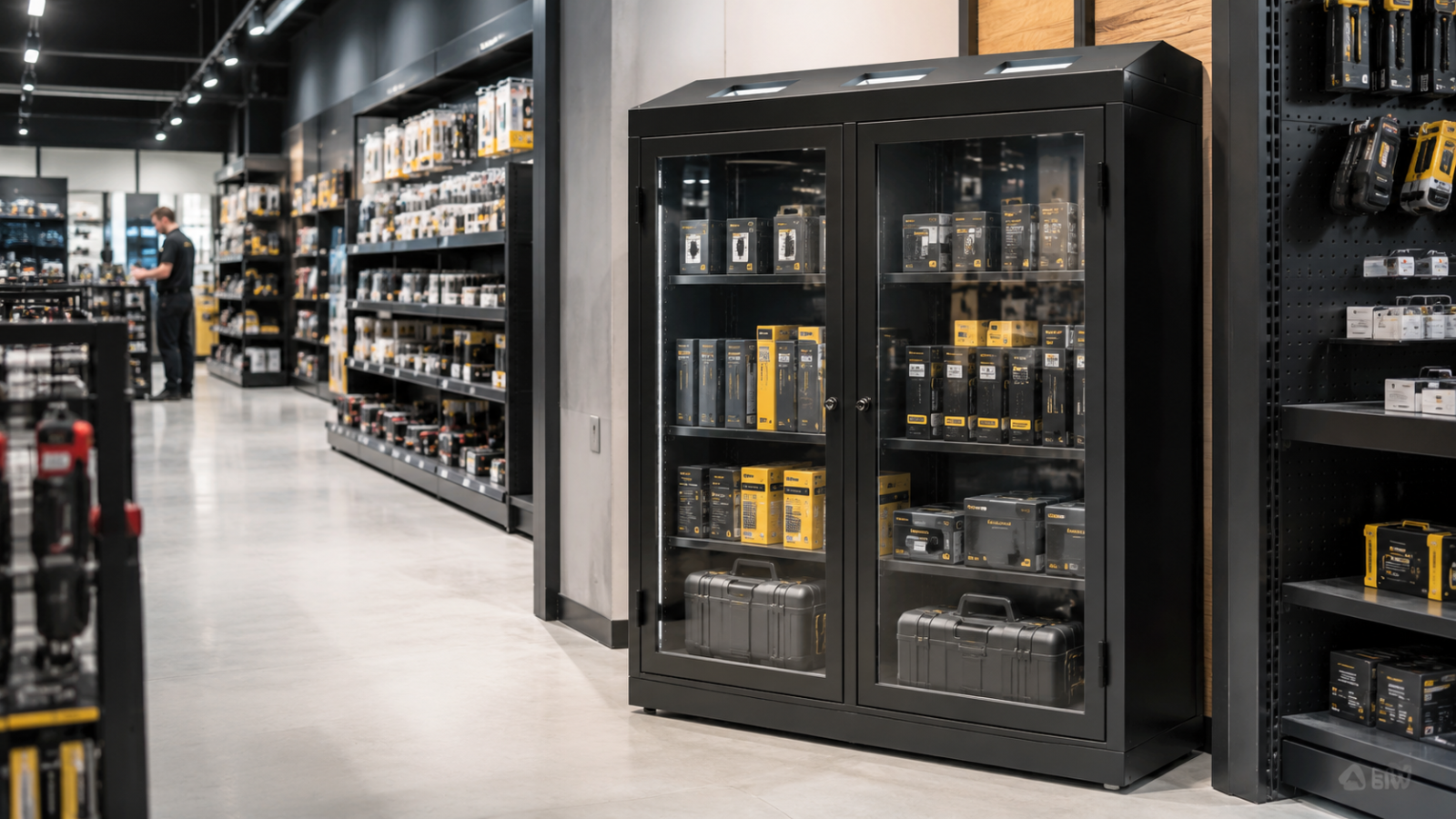
For high-ticket retail, this may include bespoke lockable cabinetry, controlled-access joinery, secured product housings, reinforced display fixtures and layouts that improve sightlines and staff supervision.
The goal is not to create a store that feels defensive or over-engineered. It is to create a more controlled, more considered environment where product protection is built into the customer experience rather than added later as an obvious retrofit.
Often, the best solutions are not dramatic. They are a combination of smaller, well-resolved design decisions that work together to reduce risk.
Why Bespoke Lockable Cabinetry Matters
Standard fixture solutions do not always respond well to the realities of modern retail loss prevention.
In many large-format and specialty retail environments, products still need to remain visible and accessible but also require stronger control. That is where bespoke lockable cabinetry can play an important role.
When designed well, lockable cabinetry protects high-value stock without compromising presentation, brand consistency or customer engagement. It can be tailored to suit specific product categories, operational requirements and store formats, making it a far more effective solution than an afterthought or off-the-shelf add-on.
This is especially relevant for categories where product interaction matters, but exposure also increases risk.
Designing Out Risk Early
Some of the strongest retail security outcomes come from decisions made early in the fit-out process.
That may mean positioning high-ticket products where staff sightlines are stronger. It may mean integrating lockable elements into custom joinery from the outset. It may mean designing fixture systems that allow controlled access to premium products while preserving visibility and presentation.
It can also extend to front-of-store planning, where more resilient built elements help improve safety and deter opportunistic incidents without compromising the overall design intent.
These are not separate security measures. They are part of smarter retail store design.
Linking Shop Design to Managed Manufacturing
The most effective security-focused fixture solutions rely on more than a good idea. They require the right connection between design, engineering and manufacturing.
This is where Retail Fixtures Australia’s managed manufacturing capabilities add value.
Our role goes well beyond simply purchasing products. We provide a fully integrated manufacturing solution that combines design, engineering, material specification, production management, quality oversight and delivery coordination through a trusted network of specialist factories.
That approach allows tailored fixture solutions — including lockable cabinetry, controlled-access joinery and other secure retail elements — to be developed with greater precision and consistency. It also means security-focused fixture responses can be repeated more effectively across multiple sites, which is particularly valuable for rollout programs.
By linking shop design to managed manufacturing, retailers gain more control over how bespoke fixtures are developed, produced and delivered as part of the overall fit-out strategy.
Better Outcomes Come from Earlier Integration
One of the most common challenges in retail security is timing. Too often, solutions are introduced late — after theft patterns emerge or operational concerns escalate.
By then, the response is usually more reactive, less integrated and often more disruptive to the store environment.
A better approach is to address these requirements early, alongside brand, budget, operations and rollout planning. This allows security measures to be resolved through the design and manufacturing process in a way that is more durable, more cohesive and better aligned with the customer experience.
For multi-site rollouts, this is even more important. Once an effective fixture solution has been properly developed, it can be manufactured consistently and deployed across multiple locations with greater confidence.
A More Integrated Approach to Retail Security
There is no single answer to loss prevention in retail. Different store formats, product categories and operating environments all require different responses.
What is becoming increasingly clear, however, is that the strongest outcomes come when security is not treated as a separate layer. It needs to be considered as part of the physical solution — built into the fit-out, resolved in the fixtures and supported through design, engineering and manufacturing.
For retailers, that means creating environments that still deliver on presentation and customer experience, while also being better equipped to protect high-ticket items, support staff safety and reduce risk.